#retrocomputing

1563 posts · Last used 3h

Some important TWIN porting updates. TWIN is a LGPL Win16/Win32 implementation started in 1993 and abandoned in 2001 that I am porting to modern-ish Linux. So, pbrush.exe shows the wrong cursors when selecting tools. It always uses the DUMMY cursor resource instead of the correct one. I couldn't figure it out so I looked at #wine code. But I still couldn't figure it out. Turns out, wine has the same bug as TWIN... I wonder how that came to be. #retrocomputing
11
1
6
0
Replying to
More important TWIN updates. Turns out that all NT based Windowses also have the same bug with pbrush.exe. So, TWIN, Wine, and NT break the pbrush cursors in the same way. I'm thinking I'm just going to remove most of the win32 support from TWIN. Wine has that covered, and focus on making TWIN support all of the weird win16 stuff it can? That might give it more of a reason to exist in 2026. I'm sure people are clamouring to run win16 apps natively on Linux! #retrocomputing
12
1
3
0
Replying to
More crucial TWIN updates: Turns out that pbrush.exe wants to directly write to the memory where Windows is storing the current cursor. On Wine, TWIN, and NT, this doesn't work because of the emulation of the cursor setting from Win16 applications. That's also why it still works on the DOS based Windowses up until ME. At least, that is what the disassembly tells me... #retrocomputing
6
1
1
0
Replying to
Important TWIN update! We now have working win16 cursors. TWIN now stores a pointer to a GDI object in the 16 bit LDT selector for certain types of objects (Cursors and Icons for now) so a 16bit app can directly change the pixel data of a cursor by treating a HCURSOR as a HGLOBAL, thereby restoring pbrush.exe to its former glory. modulo the xor cursors, because X can't do that. I'm debating software cursors. Linux can now run pbrush.exe better than NT based #windows#retrocomputing
3
0
4
0
I'm seeking a collaborator with extensive knowledge of IEEE-754 floating point math to help me devise an Intel FPU test suite for emulator authors. My previous test suites for x86 CPUs including the 8088, 8086, V20, 286 and 386 have been used by dozens of emulator authors to date. You would be participating in producing an invaluable technical resource that will help preserve the accuracy of emulation for decades to come. It would be nice if you used Discord for ease of collaboration, but you're averse to that we can work around it. Give me a private mention if interested. Boosts for visibility appreciated. #retrocomputing #vintagecomputing #reverseengineering #emulation
9
0
30
0
Replying to
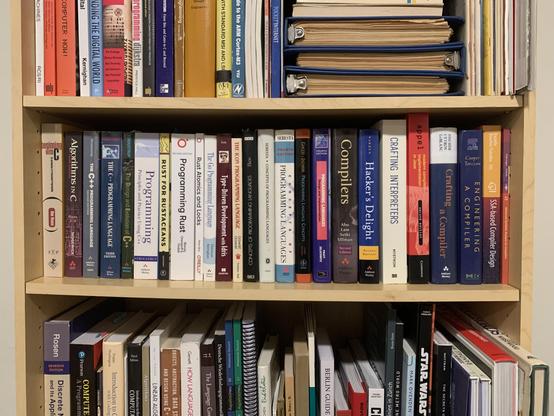
My library has grown past a single bookshelf! #vintagecomputing #retrocomputing #unix #computerscience
24
4
2
0
RE: https://discuss.systems/@thalia/117585354081746652 I love a good shelfie, especially when it's #retroComputing and #computerHistory - thanks @thalia@discuss.systems for listing the titles as otherwise I'd be scrutinising that photo
Quoting
Shelf 4 (programming languages and compilers): • Beginning with C: An Introduction to Professional Programming by Ron House (1994) • Algorithms in C, Parts 1–4: Fundamentals, Data Structures, Sorting, Searching by Robert Sedgewick (1998) • The C++ Programming Language by Bjarne Stroustrup (1991) • The C++ Programming Language by Bjarne Stroustrup (1997) • The Design and Evolution of C++ by Bjarne Stroustrup (1994) • Programming: Principles and Practice Using C++ by Bjarne Stroustrup (2008) • Rust for Rustaceans: Idiomatic Programming for Experienced Developers by Jon Gjengset (2022) • Programming Rust: Fast, Safe Systems Development by Jim Blandy, Jason Orendorff, and Leonora F. S. Tindall (2021) • Rust Atomics and Locks: Low-Level Concurrency in Practice by Mara Bos (2023) • The Go Programming Language by Alan A. A. Donovan and Brian W. Kernighan (2016) • Type-Driven Development with Idris by Edwin Brady (2017) • The Icon Programming Language by Ralph E. Griswold and Madge T. Griswold (1983) • Concepts of Programming Languages by Mark Elson (1973) • Concepts of Programming Languages by Robert W. Sebesta (1989) • Concepts of Programming Languages by Robert W. Sebesta (1999) • Programming Language Concepts by Carlo Ghezzi, Mehdi Jazayeri (1998) • Programming Languages: Design and Implementation by Terrence W. Pratt, Marvin V. Zelkowitz (1975) • Compilers: Principles, Techniques, & Tools by Alfred V. Aho, Monica S. Lam, Ravi Sethi, and Jeffrey D. Ullman (2007) • Hacker's Delight by Henry S. Warren, Jr. (2013) • Crafting Interpreters by Robert Nystrom (2021) • Modern Compiler Implementation in Java by Andrew W. Appel (2002) • Crafting a Compiler by Charles N. Fischer, Ron K. Cytron, and Richard J. LeBlanc, Jr. (2010) • Engineering a Compiler by Keith D. Cooper, Linda Torczon (2008) • SSA-based Compiler Design by Fabrice Rastello and Florent Bouchez Tichadou (2022) • Advanced Symbolic Analysis for Compilers: New Techniques and Algorithms for Symbolic Program Analysis and Optimization by Thomas Fahringer and Bernhard Scholz (2003)
Open quoted post

9
0
4
0
A few months ago, without fanfare or announcement, I started working on a new project: a brand new, handcrafted, open source Z-machine interpreter for the Apple II. This was partly inspired by Microsoft open sourcing Zork last year, and partly by the relentless flood of slop in the #retrocomputing community, and partly because I wasn't sure I could do it. After learning more about Z-machine, @a2_qkumba@mastodon.social and I settled on an insane design goal: Trinity in 64K. #AppleII #interactivefiction
20
0
7
0
A fascinating little piece of Australia's early computing history: The MicroBee. In the early 1980s, a group of engineers in Gosford designed and built a home-grown computer that competed against the likes of the IBM PC, Apple 2, and Commodore 64. At one stage, Apple even offered to buy the company to get a foothold in Australian schools. Here's the story of the rise, fall, and return (?) of the MicroBee: https://www.youtube.com/watch?v=idt-g_UQbqw #MicroBee #retrocomputing #retrocomputer @retrogaming

Australia's Greatest Computer? The MicroBee Story

20
6
21
0
RE: https://mastodon.social/@arstechnica/117571231951001103 For the old timers here, yes this is the same screen saver from 26 years ago which is evidently still going strong and it's apparently the same Jim Sachs who was lead artist on Defender of the Crown (which turned 40 this year)!? 🤯💙🐠 #RetroComputing #Amiga #Cinemaware
Quoting
Open quoted post
3
0
6
0
35 years ago, my dad chose an Intel 80386 over a typewriter – and sparked a lifelong obsession. With 1 MB RAM, a 40 MB hard drive, and a color CRT monitor, I was completely hooked. Within weeks, I had figured out COM1 vs. LPT1 and was obsessively tweaking autoexec.bat and config.sys for expanded memory. While friends played on C64s and Ataris, this was my true beginning in tech. #RetroComputing #DOS #Intel386 #VintageTech #Memories
11
1
2
0
I'd like to introduce @v4siliy@fosstodon.org, who's just joined Fosstodon! I know Vasiliy personally, and he's one of those genuinely intelligent people who always have something interesting up their sleeve. And here's a little spoiler: he might have some fascinating projects involving retro devices to share soon! 👀 If you're into retro tech, give him a follow. I have a feeling it'll be worth it! 😉 #RetroComputing #RetroTech #Introduction
0
0
1
0